Why Are Sunsets Red? Color, Clouds and Haze Explained
- Why are sunsets red?
- Does the atmosphere make red light?
- Can a scene become redder while getting dimmer?
- Why can clouds light up while the ground is dark?
- What do smoke and other aerosols change?
- Does desert dust always produce the same sunset?
- How can humidity change the appearance?
- How should you use the explanation safely?
- Sources
Why are sunsets red?
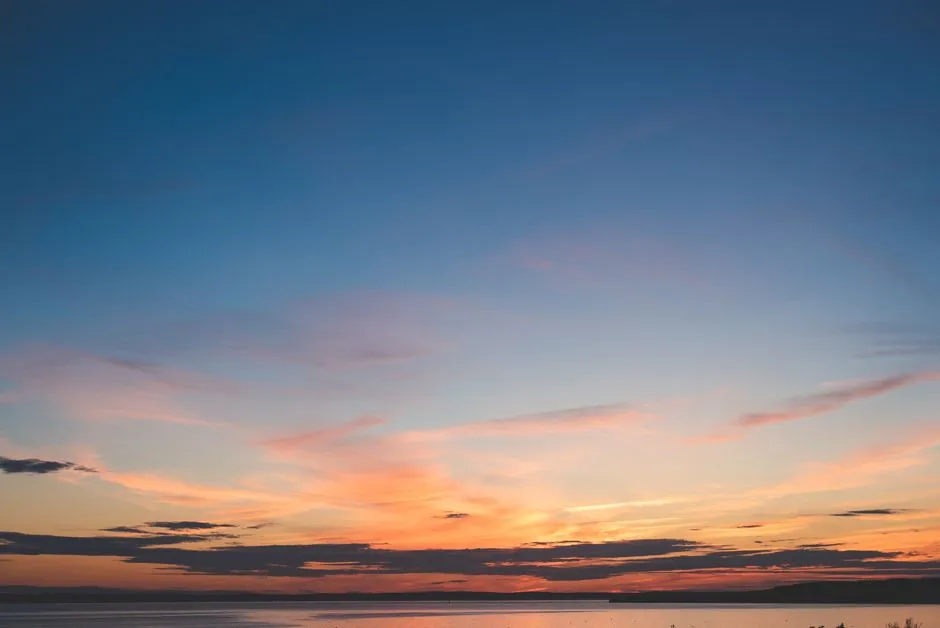
Sunsets look red or orange because low-angle sunlight travels through more atmosphere, allowing more short-wavelength blue light to scatter out of the direct beam. The remaining light is relatively richer in longer wavelengths. Clouds and airborne particles change how that light reaches us. Never look directly at the Sun to check its color; use published images, and seek expert advice before any solar viewing through optical equipment.
The useful distinction is between a change in the mixture of colors and a change in the amount of light. A redder scene need not be a brighter one. That distinction also helps explain why haze can produce a warm cast while diminishing a sunset's brilliance.
Does the atmosphere make red light?
Sunlight already contains a mixture of visible wavelengths. Air molecules scatter the shorter wavelengths more strongly, redirecting them rather than manufacturing a new supply of red. The Met Office's explanation connects daytime blue and sunset red to the same process viewed under different conditions.
At a low Sun angle, the route through air is longer. More blue is removed from the direct beam along that route, changing its balance toward orange and red. This does not mean that every blue component vanishes or that the entire sky must become red simultaneously.
For the molecular explanation, see why blue light scatters more than red. Here, the important question is which light has followed which path.
NASA's space-based example shows low-angle illumination, cloud shadows and golden cloud color together. A sunset is a spatial arrangement, not a uniform colored layer laid across the sky.
Can a scene become redder while getting dimmer?
Yes. Consider this invented accounting exercise, designed only to separate proportions from totals. It is not a measurement, a sunset simulation or a description of human color vision.
Imagine two labeled groups of equal-value counters, called short and long. Begin with ten counters in each group. Then remove eight short counters and four long counters:
| Paper example | Short counters | Long counters | Total | Long share |
|---|---|---|---|---|
| Before removal | 10 | 10 | 20 | 50% |
| After removal | 2 | 6 | 8 | 75% |
The long group now represents a larger fraction, even though it contains fewer counters than before. The total has fallen from twenty to eight. Nothing was added to the long group.
Real sunlight contains a continuous spectrum, and a real atmosphere requires far more information than these invented groups. The limited lesson is arithmetic: relative enrichment does not require an absolute increase. Avoid turning “more red compared with blue” into “more red light than there was before.” They are different claims requiring different evidence.
Why can clouds light up while the ground is dark?
A cloud needs an illuminated route from the Sun, and the observer needs a view of that illuminated cloud. Stephen Corfidi's NOAA sunset account explains why middle and high clouds often receive vivid low-angle light above a hazy lower atmosphere.
The same account describes cloud decks with a clear strip near the horizon. Light can reach beneath the deck through that opening. Clouds farther along the incoming route can interrupt the display even when the overhead cloud arrangement appears promising.
Draw Sun to cloud to observer on paper, marking a possible obstruction along either route. This is a geometry sketch, not a forecast or scale drawing.
What do smoke and other aerosols change?
Aerosols are airborne solid particles or liquid droplets. They are not all optically interchangeable. NASA's aerosol overview distinguishes scattering from absorption and explains that composition affects the balance. Black carbon absorbs sunlight readily; mineral dust's behavior depends partly on its mineral composition and coatings.
So “there are more particles” leaves important questions unanswered. What particles, distributed where, and affecting which route? A blanket rule that pollution improves sunsets ignores these differences.
Use separate descriptions for hue and brightness. “Orange but dim” records something different from “bright orange,” even though both descriptions use the same color word. Neither is a chemical identification of the particles present.
Does desert dust always produce the same sunset?
No universal color recipe follows from the word dust. NOAA's Saharan Air Layer guidance describes hazy white daytime skies and an orange sunset glow associated with that particular dusty air mass. It also describes duskier colors, so “enhanced color” should not automatically be read as “more light.”
Keep the example's scope: Saharan dust is a documented case, not proof that every orange evening contains it. Establishing an event's cause requires independent observations of the air mass.
For health decisions, follow the relevant air-quality agency's current information and advice. NOAA specifically directs readers to those authorities for dust impacts. An attractive sunset is not evidence that outdoor exposure is safe.
How can humidity change the appearance?
Some aerosol particles take up water and grow. Corfidi's separate NOAA haze discussion, section on sulfate-aerosol growth, describes this behavior even below saturation and explains how the changed particle population affects scattering. It is a particle-growth explanation, not a claim that water vapor itself paints the sky red.
That discussion also distinguishes a pale, whitened haze from vivid color and describes reduced light reaching the ground. The useful physical point is that the same broad label, “haze,” can conceal changing particle sizes and optical effects.
A humidity reading alone therefore does not specify the evening's color. Record it as one condition, not as an answer to every question about the scene.
How should you use the explanation safely?
Use existing photographs or the paper diagram, rather than inspecting the solar disc. NASA's eye-safety guidance states that ordinary sunglasses do not make direct Sun viewing safe. Solar viewing through cameras, binoculars or telescopes requires specialist arrangements and expert astronomical advice. Do not improvise an optical experiment from this article.
When evaluating an explanation, ask it to identify the light path, the relevant material and whether it means color balance or brightness. A claim that names only “pollution” or “humidity” has not yet done that work. The broader sky-color guide connects these sunset details to the rest of the day.
For a practical reading exercise, make two columns headed observation and explanation. Put a description such as "the clouds looked orange" in the first. Put the proposed cause in the second, and underline the evidence needed to support it. If the explanation adds a dust source, a particle type or a particular cloud arrangement that was never established, leave that part unresolved. A useful answer separates what was seen from what was inferred. It does not need to assign every evening a single cause.